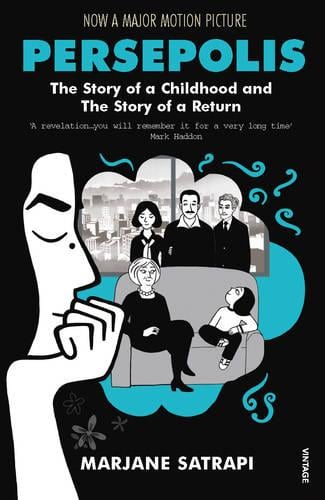
“Persepolis”
I have always had a preconceived notion of what a graphic novel is and have never considered this medium as being ‘my thing’. This book proved me wrong!
Persepolis Part 1 is Satrapi’s story of growing up in Iran and leaving at the age of 14 to escape the restrictions of life as a woman in a strict, Muslim society as well as to escape the horrific war conditions. We follow her trying to find her way as a refugee in Austria; searching desperately for a sense of belonging. Part 2 is the story of her return to Iran and in the end, her final goodbye to her country. The artwork and the words are her own – a striking combination.
As I’ve said many times before, the books I read for this book club really open my eyes to the world I live in. Though I had a general awareness of Iran, what I didn’t have, was the background knowledge for any deeper level of understanding. This book taught me so much about Iran’s social and political history. In fact, the sheer amount of information that was conveyed in relatively few words, was incredible. Satrapi’s simple, stark and sometimes shocking, artwork, made me think in a way a text book could never do. It never ceases to amaze me how powerful art can be.
Satrapi doesn’t shy away from the big themes: country identity, political and religious indoctrination and manipulation; the highs of revolution counteracted by severe reactionism; political persecution, torture and murder; the repression of women ( including the role women themselves play in this); the fundamental need to stand up for what you believe in if you want change to happen; being torn between two cultures; the extent a person will go to in order to fit in; the power of fear; drug addiction…and so the list goes on. Absolutely amazing.
At so many points when reading this book, I found myself struggling to get my head around the sheer amount of violence and death that Satrapi and many others like her, experienced on a day to day basis. This is the kind of book that needs to be read in schools, for opening young peoples’ eyes to what is happening in the world – there is so much relevant, valuable discussion material.
I am very aware that this book expresses a very honest, personal experience; I know it cannot be seen as a voice for all. I fully intend on following up with other texts focusing on countries with similar social and political and religious issues. The next book on my list is: The Morning They Came for Us: Dispatches from Syria. By Janine Di Giovanni. Giovanni, was drawn to the stories of the ordinary people caught up in the conflict when she herself was in Syria and uses this book to tell their stories.
Paperback edition
This reviewer received a free of charge product for review.