Skip to content

Reviews: How Not To Be Wrong (10)

Personal, illuminating, brilliant

Holding up a mirror to middle class views and how we have formed bias conscious and unconscious from our family, education and social setting. This is then fed into by the popular press and social media.
James makes for uncomfortable reading at time but challenges beliefs and where they come from. If you cannot agree to see an opposing side of a discussion this is not the book for you. Expands the thought process and hopefully gives you things to think about.
Hardback edition
6th October 2021
Helpful? Upvote 54

Uncomfortable, honest looks at bias

Holding up a mirror to middle class views and how we have formed bias conscious and unconscious from our family, education and social setting. This is then fed into by the popular press and social media.
James makes for uncomfortable reading at time but challenges beliefs and where they come from. If you cannot agree to see an opposing side of a discussion this is not the book for you. Expands the thought process and hopefully gives you things to think about.
Hardback edition
23rd October 2020
Helpful? Upvote 54

A brilliantly honest and refreshing account of one man's journey into a different way of living

This book opens with the line that 'there is no point having a mind if you never change it'. In a world that is increasingly polarised and blind to anyone else's opinion, this is a much needed look at how healthy it is to admit that you are sometimes, if not often, wrong. A personal journey into therapy following the ill-health of a loved one, this is an honest account of one man's ability to be proved wrong by other people's lived experiences. Tackling subjects such as discrimination, obesity, corporal punishment and issues of gender, it is written with candour and a refreshingly open mind in a world that is too often more concerned with proving others wrong, then reflecting on why those blinkered opinions are held in the first place.

As we are bombarded with opinion from every media source, and as the world becomes divided as never before, How Not To Be Wrong is a voice of reason that is much needed. We need to listen more. We need to question those in power without being accused of being snowflakes, or be accused of threatening 'freedom of speech' when actually all we are doing is scrutinising those who hold influence over society.

By examining our own opinions, fears and prejudices, we often learn that hate stems from fear or shame. It is only by looking inwards that we can change the world for the better.

It is okay to admit we all get it wrong sometimes. The world needs more of that.
Hardback edition
26th October 2020
Helpful? Upvote 53

Thoroughly enjoyable read

I was not sure what to expect with this book but found myself pleasantly surprised.

James O'Brien details how he has changed his opinions on controversial topics but he also explains his reasoning on why he held those opinions and why they have changed.

The pages turned themselves, this was a very easy read and thoroughly enjoyable,

This book also described James's personal life including his adoption and how that has shaped his life.
Hardback edition
2nd November 2020
Helpful? Upvote 15

A fascinating but depressing take on the modern world

You probably know James O'Brien from his radio show on LBC or his viral videos in debates with callers where he runs rings around their generally obnoxious and frequently racist views simply by using facts.

Ironically, a lot of what he talks about how we're lied to by politicians and the media, and what I had I thought this book would be about would be in how you make arguments and debates properly. It isn't so much that, but more his greatest hits put under the microscope and picked apart with theories on how people come to believe what they do and why people get so angry when they are asked to talk about why they believe in it. Spoiler alert, it's often because they've been misled.

Thankfully, although the book isn't what I thought it would be, it is fascinating / depressing in equal measure regarding the direction the world is currently going in.
Paperback edition
10th May 2023
Helpful? Upvote 12

The Art of Changing Our Mind

Over the disaster that has been Brexit I began to listen to James O’Brien, drawn in by his ability to apply common sense to the more bizarre arguments and to pick apart a statement or opinion so quickly and with lightning accuracy. His passion for his subject always comes across and his anger over social injustice always impresses me. However, then came the backlash. Claims that he was a bully and used a superior attitude when talking to callers were all over the papers. Also, it was claimed, his researchers only let callers through if they are members of the tin foil hat brigade. So it was interesting to read this book, which was more introspective than I’d expected and, perhaps in response to the backlash, looked at his ability to be self-reflective. It also delved back into his childhood in an attempt to explain where his philosophy and political stance come from.

His starting point is a question that I imagine he’s asked regularly, especially by those willing to discredit him. He has many detractors who imagine he considers himself correct all the time and ask him if he ever changes his mind on an issue? Of course if he says no, he’s branded inflexible and biased. If he answers yes, then he’s inconsistent and unable to stick to his opinion. In a period where the country is more polarised than ever - Remainers and Brexiteers, North and South, Capitalist or Socialist, COVID Deniers or Believers - surely it is our duty to question an issue, analyse it and evaluate for ourselves. Instead many people base their opinion on what a newsreader tells them, on what their newspaper’s headline is that week, or what their family believe. One of the most bizarre excuses I’ve ever heard for voting Conservative in my constituency area was that ‘he was the only politician who came and knocked on my door over the years’. O’Brien argues that with the divided population we have, the most powerful thing we can do is change our mind on an issue. Using himself as an example, the author looks at how our childhoods and the opinions of our parents may help form our opinions politically, leading to tribal loyalties. There’s room for loyalty, for example I never buy the Sun because my Mum is from Liverpool and their coverage of Hillsborough and the defaming of those Liverpool fans was painful and wrong. However, on political issues we need to be aware of our conscious and unconscious biases, because they may be influencing our judgement more than we realise. How do we talk to ourselves about the big issues and do we ever go beyond the soundbites, headlines and how our parents voted?

As well as personal reflection there are conversations from his radio show on a wide range of topics, but with the emphasis on how that opinion was formed and what would change his guest’s mind on the issue. Had they ever done their own research for example or do they simply trust the version they are given from the BBC. I have researched issues more lately and encourage my stepdaughters to do it too. I want them to ask questions and understand how our country got here, then form an opinion based on the facts and figures, or the anecdotal evidence from real people. I think it’s good to question the type of sources we use, whether print news or tv news is our ‘go to’ place for the truth or whether we dig further, Twitter was an eye opener to me in this sense, because I couldn’t believe how much eyewitness footage or other evidence was available in an instant when something happened. It also gave journalists the freedom to post what they wanted without censorship or editing. If it’s an important issue, multiple sources are needed to build an accurate picture. I have started to reevaluate people and admit where I’ve got it wrong in the past, but the worst position of all is having to say ‘ I really don’t like X but I do agree with him on this issue.’

I found this a really accessible look at a complex issue we all face, littered with anecdotes and softened with a touch of humour. It manages to convince that we are not ‘flip-flappers’ if we change our minds. Provided that change comes about through educating ourselves and being convinced of a different way. As O’Brien argues, if we are not willing to change our own minds, why should anyone else change theirs?
Hardback edition
17th June 2022
Helpful? Upvote 12

James O'Brien, How not to be wrong.

Courageously faces up to problems caused by abuse and upbringing. Brilliantly written.
Hardback edition
8th March 2021
Helpful? Upvote 10

Recommended Reading

We all have prejudices, predefined ideas, easy solutions to complicated problems. We all know that the world's issues could be solved by some simplistic idea that starts with "why don't they just...".
In this book, Mr O'B relates some of his simplistic solutions to complex problems. He talks about his opinions on topics of which he knew very little, and explains how he cam to realise that he was wrong, didn't understand or was prejudiced. His education, his upbringing brought him to accept concepts and ideas. Meeting and talking to real people, made him understand the complexities of the issues and how the simple solutions proposed only made the problem worse.
I highly recommend this book challenge yourself. Question your ready-made solutions. Don't believe everything you believe. Truth is complicated, people are suffering because of prejudices, just like yours.
Hardback edition
14th March 2021
Helpful? Upvote 8

The perfect antidote for a polarised world.

It’s easy to see the world in a binary way these days. James’s book perfectly spells out the benefits of being able to see both sides of an argument. Instead of picking a side and hurling rocks at the opposition, it’s always important to have an objective, fresh opinion on things. And that’s why we need to be open to changing our minds.
Hardback edition
14th February 2021
Helpful? Upvote 6

Only by accepting you're mistaken can you hope to be right in the future.

My final book of the year was this little number by James O'Brien. Incidentally, the second of his I have read this month. And a nice easy read to end the year with it was too.

While both books follow the same literary style, they are very different in approach.

In How To Be Right, James looks at 'topics of today' and offers up the rhetoric of why your view may not be the one you truly believe.

How Not To Be Wrong looks at similar topics but from a different viewpoint, one in which it's ok for you to admit that what you believed wasn't right.

Only by accepting you're mistaken can you hope to be right in the future.
Paperback edition
By Yonni.I
31st December 2021
Helpful? Upvote 5
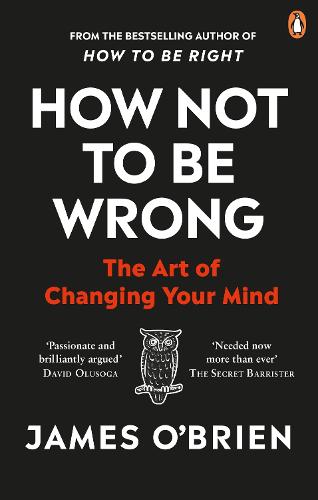
How Not To Be Wrong: The Art of Changing Your Mind (Paperback)
How Not To Be Wrong: The Art of Changing Your Mind (Paperback) James O'Brien
Price: £12.99
10 Reviews Write your review
  • In stock

Usually dispatched within 1-2 days

  • This item has been added to your basket