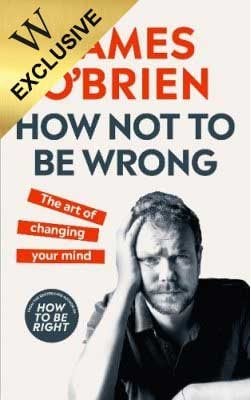
“The Art of Changing Our Mind”
Over the disaster that has been Brexit I began to listen to James O’Brien, drawn in by his ability to apply common sense to the more bizarre arguments and to pick apart a statement or opinion so quickly and with lightning accuracy. His passion for his subject always comes across and his anger over social injustice always impresses me. However, then came the backlash. Claims that he was a bully and used a superior attitude when talking to callers were all over the papers. Also, it was claimed, his researchers only let callers through if they are members of the tin foil hat brigade. So it was interesting to read this book, which was more introspective than I’d expected and, perhaps in response to the backlash, looked at his ability to be self-reflective. It also delved back into his childhood in an attempt to explain where his philosophy and political stance come from.
His starting point is a question that I imagine he’s asked regularly, especially by those willing to discredit him. He has many detractors who imagine he considers himself correct all the time and ask him if he ever changes his mind on an issue? Of course if he says no, he’s branded inflexible and biased. If he answers yes, then he’s inconsistent and unable to stick to his opinion. In a period where the country is more polarised than ever - Remainers and Brexiteers, North and South, Capitalist or Socialist, COVID Deniers or Believers - surely it is our duty to question an issue, analyse it and evaluate for ourselves. Instead many people base their opinion on what a newsreader tells them, on what their newspaper’s headline is that week, or what their family believe. One of the most bizarre excuses I’ve ever heard for voting Conservative in my constituency area was that ‘he was the only politician who came and knocked on my door over the years’. O’Brien argues that with the divided population we have, the most powerful thing we can do is change our mind on an issue. Using himself as an example, the author looks at how our childhoods and the opinions of our parents may help form our opinions politically, leading to tribal loyalties. There’s room for loyalty, for example I never buy the Sun because my Mum is from Liverpool and their coverage of Hillsborough and the defaming of those Liverpool fans was painful and wrong. However, on political issues we need to be aware of our conscious and unconscious biases, because they may be influencing our judgement more than we realise. How do we talk to ourselves about the big issues and do we ever go beyond the soundbites, headlines and how our parents voted?
As well as personal reflection there are conversations from his radio show on a wide range of topics, but with the emphasis on how that opinion was formed and what would change his guest’s mind on the issue. Had they ever done their own research for example or do they simply trust the version they are given from the BBC. I have researched issues more lately and encourage my stepdaughters to do it too. I want them to ask questions and understand how our country got here, then form an opinion based on the facts and figures, or the anecdotal evidence from real people. I think it’s good to question the type of sources we use, whether print news or tv news is our ‘go to’ place for the truth or whether we dig further, Twitter was an eye opener to me in this sense, because I couldn’t believe how much eyewitness footage or other evidence was available in an instant when something happened. It also gave journalists the freedom to post what they wanted without censorship or editing. If it’s an important issue, multiple sources are needed to build an accurate picture. I have started to reevaluate people and admit where I’ve got it wrong in the past, but the worst position of all is having to say ‘ I really don’t like X but I do agree with him on this issue.’
I found this a really accessible look at a complex issue we all face, littered with anecdotes and softened with a touch of humour. It manages to convince that we are not ‘flip-flappers’ if we change our minds. Provided that change comes about through educating ourselves and being convinced of a different way. As O’Brien argues, if we are not willing to change our own minds, why should anyone else change theirs?
Hardback edition
This reviewer received a free of charge product for review.