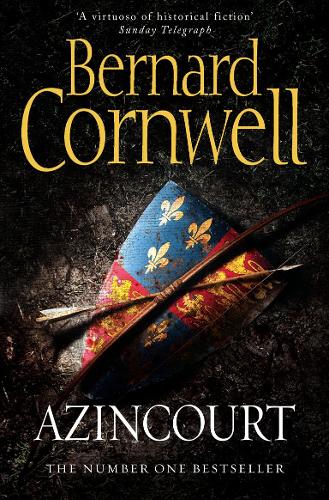
“One of Cornwell's gems.”
As the author of the famous Sharpe series, Bernard Cornwell is assuredly one of the kings of historical fiction, and Azincourt is sure to satisfy both fans of his other books and newcomers too. The novel is a vivid and visceral telling of the remarkable battle of 1415, when a small English army faced a vastly superior French force while they marched from Harfleur to Calais. Cornwell shows us the horrors of the Hundred Years War through the eyes of an English longbowmen, Nicholas Hook, an outlaw forced to join the army or forfeit his life. Guided by the voices of St Crispin and St Crispinian since the horrific siege of Soissons, of which Hook was one miserable English survivor, we follow his path through both war and the deadly feud which led to his being ruled an outlaw in the first place – his bitter rivalry with the Perrill family.
Although Hook at first seems an unlikely and unsympathetic hero, because we first meet him during his attempt to commit murder, the reader soon warms to the archer. His desire to do God’s will is his driving force, along with the desire to survive, in the face of his own fear. He is undeniably a strong character both physically and mentally, but Cornwell manages to avoid making him one dimensional, and without slowing the narration to dwell particularly on the character’s thoughts and musings, he tells the reader enough about Hook. A greater strength of the novel is its small host of minor characters, especially the fiercely authoritative and loyal Sir John Cornewaille, who leads Hook’s company of archers, and Father Christopher, the surprisingly witty priest who dons armour like a soldier, sees to the needs of the troops yet makes no pretensions to having any knowledge about God’s will. Even the chivalrous, conscientious yet down-to-earth Henry V plays his part as a minor character.
Azincourt is not for the faint-hearted, as its descriptions of violent combat and the horrors of war do not shirk from any details. The account of the battle of Agincourt is particularly relentless and really gives an impression of the full four-hour hellish confrontation, also leaving the reader wondering whether a medieval battlefield was any less dangerous than the no-man’s land of the Western Front centuries later. The medieval armies’ floundering in siege-works at Harfleur also reads like an account of trench-warfare, a parallel which is strengthened by the fact that the scene is once again Northern France, and the English army’s stand at Agincourt came after they were forced some way down the Somme valley.
Overall, Azincourt’s main achievement is the vivid picture it paints of the Hundred Years War, although the plot and characterisation do not suffer. Without giving anything away, at the close of the novel the reader’s perseverance through the gruesome battle is rewarded by being neatly brought full-circle.
Paperback edition
This reviewer received a free of charge product for review.