Stay one step ahead and let us notify you when this item is next available to order.
Enter your email below and we will notify you when this item is next available to order.
Thank you
we will contact you when this item is next available to order
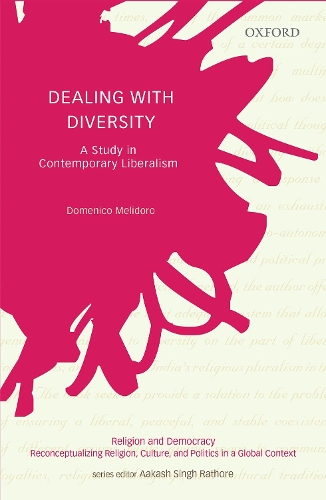
Contemporary liberal societies are marked by a certain degree of diversity indicated by coexistence of multiple ideas, doctrines, beliefs and cultural practices. But a complex and differentiated tradition of political thought like liberalism, despite its fundamental reliance on values like autonomy and toleration, adheres minimally to the principle of diversity. The triumphant position of the liberal individual dwarfs the chance of letting diversified existences fit within its boundary. However, in the face of the general depiction of liberalism as an ideology intending to guarantee creation of basic values like peace, pluralism, equality, diversity becomes a fact "that should be faced". Thus, the author in this volume works out an exhaustive theoretical classification of liberalism into comprehensive pro-autonomy, pro-toleration, political pro-autonomy, and political pro-toleration. With a detailed discussion on the different definitions of liberalism, the author conceptualises a normative framework, for liberalism to deal with the existence of the concept of diversity. The book thus presents a comprehensive account of critical evaluation of these four variants of liberalism with regard to diversity and their ability to deal with diversity in a proper way.
Publisher: OUP India
ISBN: 9780190121136
Number of pages: 180
Dimensions: 224 x 148 x 19 mm
Weight: 330 g
Language: English
 85 Seconds to Midnight
 12 Rules for Life
 The Myth of Sisyphus
 The Courage To Be Disliked
 You Don't Have To Have A Dream
 How Lucky Am I
 Blueprints
 The Boy, the Mole, the Fox and the Horse
 Moral Ambition
 Meditations for Mortals
 The Prince
 The Happiness of Dogs
Please sign in to write a review
Would you like to proceed to the App store to download the Waterstones App?