“White Woman, Green Bike, Orange Prize”
Monique Roffey: A White Woman, A Green Bicycle, and the Orange Prize
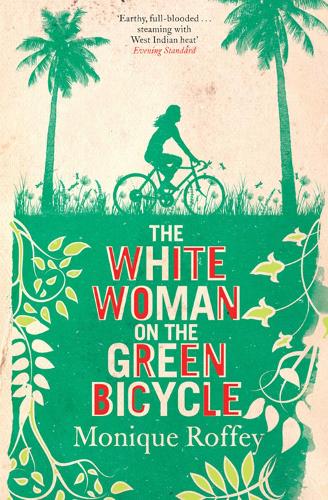
It came as no surprise to me to hear Monique Roffey had been shortlisted for the Orange Prize for her novel The White Woman on the Green Bicycle. As soon as I received it for review I knew I was in for a treat and I wasn’t disappointed. Roffey is surely one of the best women novelists around and this tale of Trinidad is as irresistible as her earlier work.
Her first novel, Sun Dog, tempted me to buy it after reading an excerpt. It’s not easy for a debut novelist to have this effect, but there was something about her fragile anti-hero as he discovered his body was changing with the seasons, sprouting buds between fingers and toes in Spring. I just had to read more and find out about this shy young man working in a delicatessen and rebelling against the commune upbringing he’d had with his hippy mother.
The White Woman on a Green Bicycle tempts the reader just as Sun Dog did. The lush landscape of Trinidad makes us feel we’re right there, or want to be there. In fact the green hills of Trinidad come so vividly to life that they actually speak to the characters and seduce them or inspire their envy.
It might be hard to imagine why one of the main characters, Sabine, doesn’t want to live there and craves the London suburban home her husband promised her if she would spend a bit of time in Trinidad while he establishes himself in his job. But, from the first days, Sabine is sensitive to the feeling that Trinidad doesn’t want her, doesn’t want the white people still living like the colonialists of the past. She’s both attracted to Trinidad and its people, and also pushed out due to her compassion and awareness. She agrees with the Trinidadians but she isn’t one of them so can’t rebel alongside them.
Her husband George is different. Like the other men sent there by businesses he can be important in Trinidad, can have a decent job, buy land and build his big house, and move on from the strong love he feels for his wife at the start through a series of affairs as the decades become more permissive. Gradually Sabine realises he will never keep his promise to take her home – this is his home. Her children are Creole and love the island, and she’s the only disappointed one: the one who doesn’t ever feel she fits in.
Roffey’s expertise is in telling this story from the point of view of both characters, Sabine and George, and keeping the reader’s empathy for both of them. In fact, we can tell that their love for each other has somehow survived. At the start of the book they’re both old and resigned to what their life has been, having given up on what they had hoped for, so I’ve given away none of the plot.
Instead of making the reader wait to see what happens we start at the end of their lives and the book lets us see back into various details. The first half of the novel is from George’s perspective, as an old man, wanting somehow to redeem himself in his wife’s eyes. The second half is told by the young Sabine from the time of her arrival on the island through the first decades of their marriage.
I particularly enjoy a book that tells me about the history of a country that I hadn’t known about, and Roffey does this in a masterful way. Not long after Sabine and George arrive the Trinidadians are roused to support the charismatic leader Eric Williams who promises to free them from the remnants of colonialism. Sabine is metaphorically seduced by him, empathising with the people, and is emotionally and physically aroused by the atmosphere he creates. I’ll say no more, and leave you to discover how Roffey weaves politics, landscape, the personal and the public figures so that the bigger picture and the smaller picture somehow work together.
If I have a criticism it’s that at times Roffey’s style can follow the day-to-day in such a realistic way that it’s possible to leave the book down and pick it up again weeks later. This happens in some chapters during the first half where we see George’s view of the marriage and Trinidad. Having said that, even his account is interspersed with vivid scenes including the beating of a black teenager by the local police that had me on the edge of my seat.
Once the story moves to Sabine’s perspective I couldn’t get enough of it. There’s always a risk when a novelist tells a story through two different viewpoints that the reader will prefer one to the other. Roffey has imagined life through the experience of both George and Sabine so well that it still feels like a major achievement, and no doubt many male readers will empathise more with George.
Compassion is a quality I look for in a novelist and Roffey certainly has it. She has written so that we can understand the history of Trinidad and this particular marriage, and she has done it without allocating blame so that we understand the reasons for the failures of individuals and even Eric Williams. The characters come to life in our minds and we remember them as if we knew them, and it’s as if we’ve been to Trinidad or want to go. It’s a novel that will stay in the mind like a memory of a real experience, and I highly recommend it.
Paperback edition
This reviewer received a free of charge product for review.