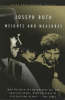
“Balancing Act”
Roth’s later novels have the precision and purity of a well-cut jewel. In this one, first published in 1934, we return to the august, unchallenged and tranquil glories of the Austro-Hungarian Empire, at the very limits of its dominion: the borderlands of Zlotograd, in modern-day Ukraine. Anselm Eibenschütz has accepted a post there as inspector of weights and measures. Together with his gendarme, Sergeant Slama, whom we have met before in ‘The Radetzky March’, he tours the district ensuring local merchants are not selling false quantities. Incorruptible, disinterested, stern, Eibenschütz embodies the Imperial ideal. If gold ruste, what shal iren do?
Alas, by a kind of reverse alchemy, Inspector Eibenschütz is transformed into a very base metal indeed. Frau Eibenschütz’s infidelity prompts him to begin an affair with a dark-eyed gypsy woman, Euphemia. He adores her. But Euphemia belongs to another, Jadlowker, into whose shady dealings at the local tavern Eibenschütz is gradually yet ineluctably drawn. If only there were some way to remove Jadlowker from the picture, Euphemia would be his, and his alone.
Although there are many different readings of ‘Weights and Measures’ - you could, I suppose, view the whole thing as a parable of sexual liberation, like the Darling Buds of May, with Euphemia in the Catherine Zeta Jones role - it seems to me that Roth is concerned most of all with the entropic decline of Habsburg rule in its last remaining years. Significantly, when the ice melts in the river, it heralds not regeneration but cholera: only a sudden return of winter re-bottles the genie of decay.
The town where all this happens, Szwaby, based on Roth’s childhood home of Brody, is a microcosm of the order and symmetry he looked back on with such longing, the Eden from which he and central Europe were so cruelly expelled. We need not look far for biblical echoes. Eibenschütz’s downfall is precipitated by two Eves: his unfaithful wife, who had also made him leave the army where he had been happiest; and Euphemia, whose untameable sexuality is, to him, both torment and joy.
Eibenschütz becomes a sort of synecdoche for the Dual Monarchy itself. Just as its statesmen attempted to balance the unruly nationalisms of the Emperor-King’s realms - a concession here, a clampdown there – so our inspector must balance his public duties, and private desires. That tree is healthiest whose branches are in equal proportions to its roots. In Austria-Hungary’s case, the branches grew at the roots’ expense, and so the tree fell down.
Paperback edition
This reviewer received a free of charge product for review.