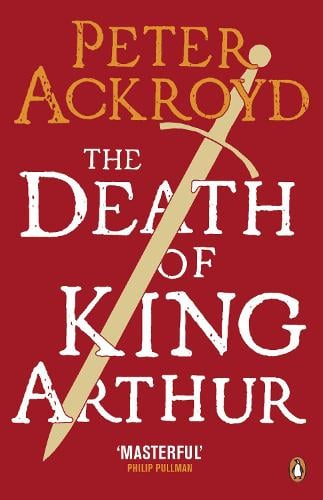
“The Death of King Arthur”
In the wild old days of the world there was a king of England known as Uther Pendragon; he was a dragon in wrath as well as power. So goes the exciting, fitting beginning to The Death of King Arthur, Peter Ackroyd’s retelling of Sir Thomas Malory’s sublime Le Morte d’Arthur. Ackroyd’s version is certainly no reimaging, staying true as it does to the tone and subject matter of Malory’s original rather than dragging the epic Arthurian romantic saga kicking and screaming into the 21st century, although he has taken the gamble of abridging certain passages to strip out any “rambling and repetitive” elements and has deliberately attempted to convert Malory’s “sonorous and exhilarating prose” into “a contemporary idiom”. As a long-time lover of Malory’s version of the Arthurian legends I was sceptical about the wisdom and, indeed, the necessity of rewriting his tales for a modern audience, but I was pleasantly surprised by Ackroyd’s book.
The Death of King Arthur begins [as is only sensible] with an Introduction, which offers a brief insight into the life and times of Sir Thomas Malory. Malory had quite an unusual CV for a bestselling [his Le Morte d’Arthur was first issued by Caxton’s press in 1485 and has not been out of print since] novelist and, as well as being a soldier, a knight and a sheriff, was accused in court documents of “rape, ambush, intent to kill, theft, extortion and gang violence”. Despite having been raised on the works of Brut and the alliterative Morte Arthur and having seemingly strived to uphold his family’s values and traditions of the chivalric code [presumably in more of a “do as I say, not as I do” fashion], it was only while imprisoned in Newgate Prison for sundry nefarious deeds that Malory began to write his epic masterpiece. Ackroyd’s biography of Malory is necessarily short but it is hugely valuable as a means of setting the scene behind the writing of Le Morte d’Arthur and explaining the tone and values, as well as the symbolism, which Malory used in his text.
Despite being entitled The Death of King Arthur, the book is primarily comprised of accounts of the reign of King Arthur and of the heroic deeds accomplished in his name by the Knights of the Round Table. Of course, the death of Arthur is foretold by Merlin prior even to the great King’s conception and so the title also serves to allude to Malory’s bleak [no doubt influenced by his life in prison at the time of writing it] view that all roads lead to death and that all of the great events of the Arthurian canon lead unavoidably to the death of Arthur.
Now whether you first came to know of the Arthurian legends through Disney films or comics or the BBC series Merlin or perhaps through a famous literary source by the likes of Tennyson or Roger Lancelyn Green or even John Steinbeck, nearly everyone has some understanding of the exploits of Arthur and the tales of the Round Table and all the favourites are recounted here in The Death of King Arthur. Amongst the included legends, we get to rediscover the reign of Uther Pendragon and his dubious wooing of Igraine; the magic of Merlin and the Lady of the Lake; the youth of Arthur and his drawing of the Sword from the Stone; of the marriage of Arthur and Guinevere; the adventures of Sir Lancelot; Sir Gawain, Sir Bors, Sir Galahad and the Quest for the Holy Grail; and the darkness that draws in on Camelot and of the fall of Arthur. These are classic stories that resonate down through the centuries and are just as exciting and compelling now as they were when the ink was still wet on the first edition of The Mabinogion.
Overall I really enjoyed The Death of King Arthur. It doesn’t matter how many times I have read them or how many editions I own, I love the Arthurian legends just as much today as I did when I first heard of them [through T.R. White’s The Once and Future King if memory serves]. I’ve always enjoyed Peter Ackroyd’s writing style previously and, even when effectively rewriting someone else, his tone in The Death of King Arthur is just as elegant and precise as I expected. His conversion of Sir Thomas Malory’s prose into a form more recognisable to modern readers is unobtrusive and doesn’t detract from the power of the original legends. In the same way, the abridgements that he has made to the text do not leave any particular gaps in the story. In fact, the changes are so unobtrusive and the language choices, while different from Malory’s choices, are not too different nor are they particularly ‘modern’. Ackroyd clearly has a great deal of affection for Le Morte d’Arthur and that has what inspired to produce such a faithful recounting of Malory’s book, but it is so faithful that it is perhaps almost redundant. Le Morte d’Arthur isn’t a difficult book to follow or understand and so, while The Death of Arthur is, because of its subject matter, a great book to read, it would have perhaps been more interesting if Ackroyd had compiled his own collection of Arthurian legends, making reference to numerous sources, rather than just reworking a book that is still both accessible and much loved.
Ultimately, The Death of Arthur is a solid retelling of the excellent saga of King Arthur and his knights and, while it might not piqué the interest of those who know and love Malory’s Le Morte d’Arthur, it is a thrilling and true collection of the classic British legends that have inspired and enthralled generation after generation of readers.
Paperback edition
This reviewer received a free of charge product for review.