“A Brief Summary and Review”
*A full executive summary of this book will be available at newbooksinbrief dot com, on or before Tuesday, April 16, 2013.
You open up a bag of chips intending to eat only a few handfuls. You find the chips tasting quite good, and a few handfuls turns into a few more. Just one more... o.k., last one... definitely the last one. A few minutes later you find yourself staring down at an empty bag. Then your stomach starts to hurt--then your heart. The guilt isn't far behind. Who among us hasn't experienced this at one time or another? This is junk food in a nutshell: it tastes great (practically irresistible) and is very convenient, but if you indulge too much (which sometimes seems all too easy), it's not too good for you. All of this has an easy explanation, it's right there on the label: impressive portions of salt, sugar and fat, the junk food trifecta. Each has its own appeal, and each is very inexpensive (which explains why it's in our food), but over the years each has also been implicated in some of our most common and serious conditions and diseases, including obesity, heart disease and diabetes.
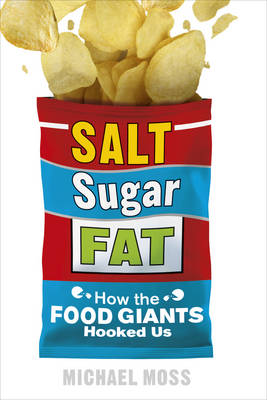
Unfortunately, the junk food trifecta is not only popping up in our junk food, it is increasingly being featured in virtually all of the processed foods that we eat--from chips and soda, to canned food and prepared meals, to cake and ice-cream. And as salt, sugar and fat have become more common in the foods that we eat, the conditions and illnesses associated with their abuse have reached epidemic proportions. In his new book Salt Sugar Fat: How the Food Giants Hooked Us journalist Michael Moss takes us behind the labels and explores the history and practices of the processed food industry--a story that features the rise of salt, sugar and fat, and the deterioration of our health.
Moss divides his book into 3 parts, one for each of salt, sugar and fat (not in this order).
In Part I, on sugar, we learn how the proceed food players have used very precise science to identify just what amount of sugar they need to add to their products to hit our `bliss point' (a self-explanatory concept). We also learn how the bliss point (as well as marketing) has figured into the evolution of breakfast cereals, the soda wars, and the composition of so-called fruit drinks (such as Tang, Kool-Aid, and Capri Sun)--as well as many other processed foods. Interspersed throughout we learn about the emergence of science that has fingered sugar as a major culprit in numerous health concerns from tooth decay to obesity and diabetes.
In Part II, on fat, We learn how this substance, unlike sugar, has no bliss point, but is instead something whose allure just seems to keep on rising the richer it is, and the more of it we find in our mouths. The focus in this section is on the history of processed cheese, and the explosion of cheese consumption since the 1970's. This explosion, we find, has been aided and abetted in the United States by certain government policies and interventions. Indeed, while one arm of the USDA has identified cheese as being a source of deep concern for its high quantity of fat, another arm has actively promoted it through a marketing program intended to prop up the dairy industry. Processed meat is also discussed in this section, with a special focus on hamburger and bologna.
In Part III, on salt, we learn how our taste for salt can be amplified through increased intake (and how our blood pressure tends to suffer as a result). We also learn how salt is used in the processed food industry for a plethora of purposes from enhancing certain flavors, to masking others, to adding crunchiness to products, to delaying spoilage. Finally, we learn of the ins and outs and ups and downs of the snack food sector, with its heavy reliance on salt (as well as sugar and fat).
The journalistic expose is inherently a tension-filled genre. On the one hand, there is often an issue of real public concern at play; but on the other hand, it is ever in the interest of the journalist to inflate the controversy (and the blame). Moss does do a fairly good job of steering clear of these traps--for the most part--though the objective reader will occasionally rankle at Moss' presentation, and his choice of words and focus. On the whole, I've come away with a renewed interest and concern in just what goes into the food that I eat, and how much salt, sugar and fat it contains--and this, I think, is very valuable in itself. A full executive summary of the book will be available at newbooksinbrief dot com, on or before Tuesday, April 16. A podcast discussion of the book will be available shortly thereafter.
Hardback edition
This reviewer received a free of charge product for review.