Skip to content

Reviews: Ostland (4)

Ostland

One of the most remarkable reads ever. Harrowing, thought provoking and brilliantly written. A must read !
Hardback edition
By IK
20th December 2017
Helpful? Upvote 47

Ostland

If what you are looking for is a historic police procedural that blossoms into an indictment of the horrific actions of the Einsatzgruppen in and around Minsk, then this is simply perfect. The book divides into almost three distinct sections. The first follows the historic war-crimes trial of Dr. Georg Heuser and his cronies in the early 1960's using actual court transcripts at times and following proceedings through the eyes of Dr Paula Siebert, a young lawyer investigating the crimes that took place in Minsk during the early 1940's. The second and third parts of the story are seen as almost a memoir written by Heuser; first charting how he came to be a rising star in the Brelin Kripo, helping to catch an infamous serial killer - The S-Bahn killer - a man who had an almost Ripperesque grip on Berlin during the late 1930's and up until his capture and execution in 1941. The second part of the memoir shows Heuser's descent into criminality as a SS Hauptsturmfuehrer in Ostland. The 'memoir' sections are quite brilliant in their convincing blend of horror at the atrocities going on around the young officer, and repeated insistence that he was 'only obeying orders'. This section manages, without lifting the onus of responsibility, to show how ordinary men are able to be twisted into committing the most atrocious acts of inhumanity; and how their warped sense of morality can lead them to see the most banal acts of kindness as great humane gestures. At times when reading this I couldn't help but think of the wonderful, but terrifying scene in the film Schindler's List when Amon Goeth shows 'mercy' for the failure of his slave to properly clean his bathtub. The moment when Goeth loses interest in this act of 'generosity' is portrayed with such chilling skill by Fiennes, as instead of offering a blessing to his own reflection he becomes caught up in his own need for a manicure. This same consummate skill was shown here in the duality of Heuser as he thinks to seduce a young woman he has just rescued from the death pits; as well as the way in which his lawyer's mind attempts to reconcile the criminality of what he is doing with his own moral code. At one point Heuser describes the hideousness of realising that the men he is now charged with killing are not 'less than fully human' as the propaganda states, but are in fact members of the Reich, men who have loved and served their homeland..

'It was as though the who grotesque business were a gigantic experiment, conducted by a mad, all-powerful psychiatrist who sought to establish just what terrible sins once-decent men might be capable of if correctly manipulated. 'We have established that you can bring yourself to kill people who look and sound alien. Very well then, what if they look and sound just like you? what if they come from the same cities, even the same neighbourhoods - how will you manage then?''

It is a fact that the majority of the Einsatzgruppen in particular were ordinary men, often policemen used to upholding law and order, and that even the harshest amongst them found themselves reacting physically and mentally when confronted with the horrors or the Latvian and Belorussian campaigns. These men became inured to the horrors, certainly but they also became alcoholics; insomniac drunks haunted by the atrocities they had seen and done. It was due in part to the potential break down of moral and the mental state of the men taking these 'actions' that the idea of gas chambers was posed. Not only did the solution of gassing the victims meet with the approval of Heydrich on grounds of efficiency (quicker, higher volume mass murder possible and no expended bullets) but also it spared the men from having to witness the brutality of mass murder at close range. Even Heydrich recognised that 'good German men' would not be able to stand up to the strain of repeatedly shooting men, women and children in the back of the head for any extended period of time. This is the paradox that this novel explored quite brilliantly; that of the legal framework for mass murder, and of using men born to uphold justice to commit the worst offences. This book handles the issues involved wonderfully.
Paperback edition
20th December 2017
Helpful? Upvote 45

A must read...

To simply label Ostland as a crime thriller would not only do a great disservice to the sheer power and scope of this novel, but would in turn devalue a book that truly encompasses the very best elements of both the crime and historical fiction genres. This is without a doubt one of the most affecting novels that I have read, so much so, that at times I had to take a breath, emotionally undone by the, at times, harrowing depictions of one of the greatest evils perpetrated in the history of mankind, which is so strongly brought to the reader’s consciousness. This is not a book that just deserves to be read but a book that also needs to be read…

From its deceptive beginning as a seemingly straightforward and compelling crime read, Thomas not only manipulates our emotions to the central protagonist, Georg Heuser, but then allows us to bear witness to the atrocities committed by the Nazi regime during the latter stages of World War II. Opening with the real-life investigation of a brutal serial killer, stalking the S-Bahn network, Heuser makes his entrance as a young idealistic detective, driven by an innate sense of morality in the hunt for a killer. At the close of the S-Bahn killer case with the apprehension of the murderer Heuser tries to come to terms with his encounter with “a genuinely evil human being” and that to enter the killer’s mind was to “enter a world of violence, degradation and filth, a world without pity, morality, or any feeling whatsoever for his fellow human beings- a world with which I had nothing in common at all” and a sentiment of the young Heuser that remained in my mind throughout the book. With the indelible links between the German security departments Heuser quickly comes to the attention of SS-Reinhard Heydrich and his cohorts, and being promoted to SS-First Lieutenant is despatched to Minsk, an area where half the population is Jewish and which quickly becomes a major processing centre for Reich Jews and the beginning point for Heuser’s descent into evil, previously such an anathema to him.

What strikes me most about this novel is the adept way in which not only Thomas assails our sensibilities in his description of the harrowing processing of the Jews, using at times the most understated of images to convey the horror, but how the almost banality of murder imprints itself on the consciences of those despatched to accomplish this task. Hence, our empathies and reactions to Heuser are consistently manipulated and changed, as we bear witness to his actions, and through a parallel post-war storyline involving the bringing of war criminals to justice. Suffice to say that our original perceptions of Heuser as a formerly steadfast harbinger of morality are significantly coloured by the extreme brutality that we witness in the latter half of the book- a brutality that Thomas evokes so deeply in our minds through the powerful and affecting nature of his writing, that at times is almost too uncomfortable to bear but so necessary to read. Thomas’ evocation of historical fact, and the prevailing atmosphere of evil, gives rise to some of the most powerful writing I have experienced, and a true study of the shifting nature of morality and its indelible role at the heart of our inherent instinct for survival.

In conclusion, I can only say that Ostland is a book that transcends our expectations as crime readers, and is a richly rewarding read. It effortlessly causes us to engage with it, never shying away from the realities of evil and the destruction of morality it brings in its wake. A novel that unerringly stimulates the thoughts and emotions of the reader, compounded by the harsh realities of human history that form its foundation. Quite simply, a must read.
Hardback edition
By Raven88
20th December 2017
Helpful? Upvote 35

Challenges preconceived perceptions

David Thomas has presented a fascinating exploration into the mind of a Nazi war criminal. In a book of two parts we are firstly introduced to Georg Heuser the dogged, diligent and somewhat brilliant police officer, instrumental in the capture of a notorious serial killer. In itself this makes for an intriguing book, delving into the mind of troubled man plagued by his gruesome childhood culminating in the slaying of several women. Orgazow is certainly worthy of his own book, he ticks all the boxes signifying a brutal sexual sadist. This first part is gripping and as the investigation winds down the war and the Nazi's 'Jewish problem' increase in their respective horrors and intensity.

By this point Heuser has proved himself to be a decent Human being, determined to be the best police officer he knows how to be. Quickly rising up the ranks he comes to the attention of those in authority. When the time comes to utilise police officers in the ever growing 'Jewish problem' Heuser is deployed in the occupied territories in Russia, his base of operations is Minsk, and is known as 'Ostland'.

Many Germans, whether members of the Nazi party, Gestapo, or otherwise, had heard the rumours of what was happening to the Jews, but either dismissed them as enemy propaganda or applauded the actions carried out against these 'lower than Humans'. Heuser, through the pen of Thomas and with credence as attested by the wealth of research, was never a member of the Nazi Party and had never considered the Jews a threat. For him they were merely Germans with different beliefs. Once settled in Ostland and faced with the orders to exterminate with efficiency these problematic Jews he faces a dilemma.

This part of the book is exceptional. Heuser's inner dialogue during which he questions his own character and the validity of the orders he has been given makes for an interesting debate on the issue of following orders which are blatantly both criminally wrong and morally reprehensible. He and his subordinates feel compelled to do their duty at the expense of their souls. As mentioned in the book the burning of evidence and the vast quantities of Vodka consumed are telling indictments of the German high command's culpability and the men's struggle with their moral guilt and trauma of their actions. I know we are supposed to despise the Nazis for what they did to millions of fellow human beings, Jews, mental defectives, homosexuals and so on, but I found myself feeling a teeny-tiny smidgen of sympathy.

The issue of following orders from authority figures has been researched by Psychiatrists, Psychologists and Criminologists for many years and the body of research findings does support the Nazis' contention that doing their duty was paramount. To fail in their duty went against the proscribed ethos of what it meant to be both a good Nazi and a good a and soldier. In more recent times soldiers faced with such repugnant orders have had the good sense to question them, but these modern soldiers do not have the burden of indoctrination or threats of a firing squad hanging over them, unlike the soldiers of the Reich. This is very ably dealt with during a couple of conversations between Heuser and Hannah, and also by Heuser and Von Toll. Also between Paula and Kraus, and Paula and her former Professor. No doubt you will find yourself pondering this moral dilemma as I did. Is it fair to say that the majority of these men would not otherwise have been criminals but under the circumstance of war and Nazism, their duty and orders made them do criminally and morally wrong deeds? I say yes, but this is in no way a condoning of those war crimes, but merely an understanding of their predicament and mind-set at the time.

The last few chapters are especially good, they evoke the gamut of emotions from anger to pity. I found it to be something of an emotional roller-coaster of a read. At the same time I found myself thinking that this book absolutely has to be included in the required reading of school curricular, especially for those studying Psychology or Modern History. It is astonishingly good despite its somewhat graphic detail. I cannot recommend it highly enough.

A final note on Heuser - I felt that Thomas's representation was accurate and having read into him a little more I would say that he genuinely believed that what he did during his time in Ostland was simply part of his being a good German, a good policeman and more importantly a good SS officer and soldier. It is a difficult pill to swallow but a fair assessment of the man, however, the final page in which Thomas makes an observation about the trial and its outcome will have you questioning everything once again. I struggle even now to reconcile my opinion of Heuser in the face of this comment from Thomas and the harsh reality of Heuser's actions as a pawn of Nazi ideology!
Hardback edition
5th February 2018
Helpful? Upvote 18
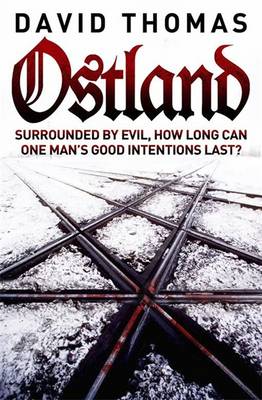
Ostland (Hardback)
Ostland (Hardback) David Thomas
Price: £16.99
4 Reviews Write your review
  • Out of stock

Currently not available to order

This product is currently unavailable online. Click to be notified when it is back in stock or to collect in store.