Skip to content

Reviews: The Rag and Bone Shop (12)

The meaning and nature of memory

Psychiatrist Veronica O'Keane explores the meaning and nature of memory.

Drawing on clinical observation, and referencing literature, film and folklore, O’Keane covers the latest research in neuroscience, as well as giving a potted history of what we understand of memory and the mind, a tour of the brain, and an explanation of biographical and cultural memory.

The aspects covered are so wide-ranging, this book is likely to be one which the average reader will dip in and out – I’ve marked several passages I want to return to in future.

Well-researched, accessible and enthralling.

My thanks to NetGalley and Penguin Press UK for the ARC.
Hardback edition
7th February 2021
Helpful? Upvote 31

Mind blowing!

This book I found so interesting, with an in depth look into the subject matter on the complexities of the brain and how memories are made and formed (along with instances of how this can sometimes go wrong or be affected in different ways!).

The author discussed and brought to the reader the information in an entertaining and informative way and was broken up into digestible chunks to prevent things from getting a little overwhelming!

The brain is such an amazing thing and I think within every person is a child-like fascination into the brain and how it works. So with all of those who are awe struck by the brain and all it can do, this book is beyond perfect. I think many would benefit from reading this in so many ways. It’s impossible to read this book, not be mind-blown or come away with at least one very interesting and astounding thing you’ve learnt. I definitely learnt a lot.

It’s true, I’m a scientist and a science lover so topics like these will always fascinate and interest me but I think anyone with a passing interest in the brain will find interest. I learnt and took in a lot and found it to be structured so well that the information flowed easily from one point to another.

I loved that the author included case studies and her own experiences which was just so interesting to read. I was enraptured! It has a great balance between science, providing the basis for understanding on the subject, the authors own encounters and case studies. There’s also some great illustrations, pictures and drawings which really help to bring a visual aspect to some of the more technical parts. I loved the references to literature too and the relationship to the illnesses that the characters may have been experiencing at the time. As well as the writings on the links between physics, time and our brains on time and perception.

It was great to read about the authors career and her encounters too and overall, I found the book very informative and enjoyable with many notable sections that I think will stay with me for some time to come!

I was lucky enough to read this with thanks to the author and publishers via Netgalley for an honest review.
Hardback edition
5th February 2021
Helpful? Upvote 28

An accessible exploration of how humans develop, recall & process memories

The book delves into the scientific and cognitive processes that are involved in creating & recalling memories, but also what consciousness really is and how our idea of self is developed.
Overall this is an accessible exploration of how humans develop, recall & process memories and the links with emotions. There is enough science to ensure credibility, but also references to literature and folklore as well as case studies, anecdotes & stories from the author’s practice as a psychiatrist to make it interesting & relevant. I particularly enjoyed the historical sections, looking at what we use to think about the brain & treat those who were mentally ill compared to current practice.
It’s quite a serious book & not one to skim read, but the style of writing makes it easy for the non-medical person to understand, though it will be of more interest to those with an interest in science or perhaps someone looking to delve into memory after having a loved one diagnosed with Alzheimers or similar.

I am not sure about the title (taken from a W B Yeats quote “the rag and bone shop of the heart”) and think that the subtitle “How We Make Memories and Memories Make Us” would be better explored as a title.

Disclosure: I received an advance reader copy of this book free from the publisher via NetGalley. Whilst my thanks go to the author, publisher and NetGalley for the opportunity to read this, all opinions are my own.

#TheRagandBoneShop #NetGalley
Hardback edition
8th February 2021
Helpful? Upvote 24

An accessible look at memory processes and their importance for human life & selfhood

3.5*
 
As per the tagline, in The Rag and Bone Shop, O'Keane is looking at how we make memories, and how they make us.
The book spans a range of content, from the specific processes involved in the brain to understand, form and store sensate experiences as feeling memories to the intersection of memory with wider concepts such as consciousness, selfhood and collective memory.
 
The focus of the book is not quite what I had expected, but this is on me as I was looking for something a bit more flowery and philosophical whereas this takes a more scientifically detailed approach of looking at memory processes themselves, supported by key psychology case studies and those of her own personal and professional experience.
 
I do feel that I have come out of this book with a better technical understanding of memory as well as a new perspective as a reader of human stories in terms of how narratives are constructed and the interplay between age and mental illness with memory and perception.
 
O'Keane's journey through memory also took on a personal significance for me, as we moved through the chapters I was able to revisit many cherished memories and reflect upon their pervasiveness in my life and identity.
 
Like all writings that are so broad in scope, some chapters were more appealing to me than others. I particularly enjoyed those touching on the significance of place for the recall of memory and emotion and on the way in which memory is constantly in flux and reconstructed in the context of the present. Likewise, there were areas I would have liked to have seen O'Keane push a bit more, the section on collective memory in particular felt a bit weak and limited. I also think it would have been valuable to see more non-Western perspectives embraced in the volume.
However this is of course a very personal commentary of what I find interesting and would like to think about in a bit more detail.
 
Overall this is an accessible and wide reaching look at the human experience/process of memory that I think would serve to open up new perspectives and ideas with which to consider almost all areas of life (due to the all-encompassing nature of memory!) and if nothing else, will take you on a (mostly) pleasant trip down memory lane.
 
"Present experience and memory are in a never-ending dance of construction and re-construction"
Hardback edition
4th February 2021
Helpful? Upvote 14

Fascinating journey into humankind

Written by a neuroscientist, this book delves deep into the workings of memory, self awareness and consciousness. Although the book gets quite technical at times, everything is explained so it's accessible to the layperson and the author draws from her clinical experience to give plenty of illustrative case studies. For lovers of literature, O'Keane also gives lots of examples of how great artists like Proust, Sartre and Dostoevsky wrote about the experience of memory and consciousness before modern science was able to explain the processes involved. It's an utterly fascinating and mindblowing read, and I would recommend the book to anyone who's interested in the human condition.
Hardback edition
16th February 2021
Helpful? Upvote 13

Fascinating

A fascinating deep dive into psychiatry and mental illness. I particularly loved the case studies but the background information about neuroscience was really interesting too. Meticulously referenced and very readable.
Hardback edition
1st February 2024
Helpful? Upvote 9

It was a brilliant and indulgent read

I was very curious about how memories are actually formed as I've read a little about it before, but I never thought of the way memories do form us in a way.
This book was full of discoveries for me. I was taking my time with it as so many things needed to be digested slowly. It definitely wasn't the one to rush.
It is written in a language that is easy to read and understand, but it gives you such an in-depth look into how our brain works in the memory department and how it may affect us in all different ways.
It was a brilliant and indulgent read. I have thoroughly enjoyed it!
Hardback edition
By Kate
8th April 2022
Helpful? Upvote 8

3.5

Divided into two parts, the first centred around explaining "how we make memories" and the second around "how memories make us", Veronica O'Keane's attempt to demystify memory takes from several domains to tackle her subject matter.
Mostly drawing from established and recent neurological discoveries, she also integrates case studies and literary insights to further illuminate her explanation of the cognitive processes involved in memory.

O'Keane being a psychiatrist with decades of experience across the British Isles, she provided me with a deepened knowledge of how phenomena such as psychosis and stress are experienced and how memory works (or doesn't more like) when experiencing these. It was also a good refresher in terms of brain anatomy and processes, though frankly some of it did go over my head after a while.

While the literary references were nice in some respect (i.e. a bit of a solace from the dry science), I am not convinced that it was a successful integration that ultimately created a sum larger than its parts.

I would say that for me this book is more of a 3.5 stars. I did take quite a lot from it, but in fairness it wasn't exactly a page turner due to the nature of its content and, while engaged and interested, I didn't fly away with it.

Let's hope now I can remember at least the most salient parts from it.


Many thanks to Penguin Press UK and NetGalley for sending me a copy of this book in exchange for an honest review.
Hardback edition
19th January 2022
Helpful? Upvote 8

How memories are made - the hard science

O’Keane is a psychiatrist and this detailed book delves into what makes memory, feeling and abnormal states such as psychosis - including after having given birth - and dementia. She also delves into false memory, trauma and collective memory.
She combines neuroscience, biology and psychiatry, mixed with a dash of fairytale and folklore!
She includes some fascinating case studies - patients she has seen over her career.
There is a lot of physiological detail which makes this a technical read. It is so dense that I ended up reading it in bite-sized chunks.
There were so many ideas covered here that I sometimes felt that I was skipping around inside O’Keane’s brain.
Recommended for those interested in the hard science of what makes us tick.
Hardback edition
8th March 2021
Helpful? Upvote 7

Fascinating and accessible

The Rag and Bone Shop is a fascinating account of memories - how we form them, and how the areas of our brains interact to allow us to access them. It also examines how mental illness and brain disorders affect our memories. Written by a psychiatrist, the author draws on real life case studies which brings the subject to life. History and philosophy also form the background to this examination of neuroscience, and despite some scientific detail, it is quite accessible to the layperson.
Hardback edition
4th February 2021
Helpful? Upvote 7

10/10

I would 100% recommend this book to anyone. It’s very interesting, such a page turner. You also learn a lot, it will really develop your understand of the human mind.
Paperback edition
31st July 2022
Helpful? Upvote 3

Simple language, but pay attention and you will learn so much

‘The Circus Animals’ Desertion’ was the final major poem published by W. B. Yeats in his last volume of poems. In the last line, he talks about ideas springing from ‘…the foul rag and bone shop of the heart’. In her book, The Rag and Bone Shop, Professor Veronica O’Keane explains how the various parts of the brain – the cortex, hippocampus, insula, amygdala, etc. – work separately and together so that we sense – and make sense of – the world.

O’Keane gives a lot of information in straightforward language but doesn’t talk down to the reader at all. She does, however, expect us to keep up and give her the courtesy of paying attention. This is not a casual read but the reader who engages with the text will have a great understanding of how the brain works. My view of mentally ill people has changed from a simple – possibly slightly scornful one, to my shame? – to a much more sympathetic one. O’Keane states “Hearing a sound, a human voice, is a subjective experience, whether the voice originates in the outside world or is generated in the brain by pathological neuronal firing. The experience of hearing the voice is similar in both cases.” In other words, whether another person in the room is speaking to you or you are alone, your brain is behaving in the same way and it tells you that you have been spoken to.

The sections on biology and neuroscience are interspersed with case studies from her career. This combination of science and humanity makes the book so rewarding to read. O’Keane states “Memory is, in its essence, the infinitely complex neural representation of sensory information that has been carried to the brain.” And “Ultimately, what is memory without emotion – an endless repertoire of experiences without any human meaning. And emotion without memory? A shallow flitting from one object of desire to the next.”

Why is it that, like Proust, a scent or a phrase or the sight of an object, can cause a rush of memories and the emotions we associate with the trigger? O’Keane quotes Donald Hebb’s brilliant phrase, “Cells that fire together wire together.” The first half of the book tells us about the role performed by various parts of the brain and the second half explains the process of memory. Although Beethoven couldn’t hear external sounds because the auditory nerve passing sensations from his eardrum to the auditory region of his cortex no longer worked. However, his auditory cortex remembered the sensation of hearing various notes, instruments, etc., and send neural representations of those sounds (memories, to you and I) onto his prefrontal cortex. Therefore, Beethoven could imagine how his music would sound. The staggering thing is that his brain was putting all those individual memories (piano, trumpet, singers) together in a way that they had not been combined before. He had to imagine ALL the new music he wrote after becoming deaf.

As I said, this is not a book to read casually - the language is simple but you do need to keep up. If, though, you’re willing to concentrate, you will have a great appreciation of brains, thinking and memories.

#TheRagandBoneShop #NetGalley
Hardback edition
11th February 2021
Helpful? Upvote 3
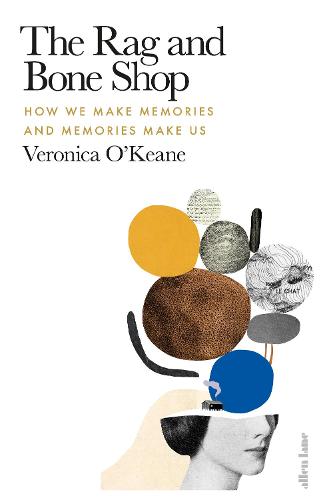
The Rag and Bone Shop: How We Make Memories and Memories Make Us (Hardback)
The Rag and Bone Shop: How We Make Memories and Memories Make Us (Hardback) Veronica O'Keane
Price: £20.00
12 Reviews Write your review
  • Out of stock

Currently not available to order

This product is currently unavailable.

  • This item has been added to your basket