Skip to content

Reviews: The Librarian of Auschwitz (9)

Inspiring

The Librarian of Auschwitz is based on the life of an amazing teenager, Dita Kraus, who takes on much more than any young girl her age should. At fourteen she finds herself in the Family Camp at Auschwitz with her mother and father, a camp that has special privileges, where they don’t have their hair shaved and the children have somewhere to play whilst their parents work. The reasons behind this camp are not understood by the inmates, although the reason is explained during the book. Block 31 is a place where the children are meant to play during the day, but Fredy Hirsch with the help of others actually runs the block like a school, and Dita is their librarian of the eight precious books that have been smuggled in. Books and education are dangerous, and if found out they would all be killed.

This is such a remarkable story in so many ways; it attests to the bravery of all those interred at Auschwitz, they put their lives on the line for extras to make life slightly better and to give the children an education and a routine to try and take their minds off what is happening in the camp. Dita is a determined young woman who takes her responsibility as the librarian seriously, there may only be eight books but in Auschwitz that is eight too many, an after gaining the attention of Dr Mengele she still won’t give in to fear. The importance of books and their power to transport the reader to another place and time, to give knowledge is an important message in this book; as some of the family camp are taken to the ‘showers’ Block 31 uses the books to distract the children from what is going on around them.

There is no doubt that Dita’s story is remarkable, and one of courage and determination is such horrendous circumstances. As well as her story we hear of others bravery as well; Fredy Hirsch who runs Block 31 and sees himself as the children’s protector, Rudi Rosenberg, a registrar in the quarantine camp who falls in love with Alice, also in the family camp, and an SS Guard Viktor who doesn’t believe in the Nazi regime and wants to escape. These stories show how hope, belief and courage overcome the fear of what is going on around them and give them some optimism of maybe a life after the war.

Obviously this is a heartbreaking and harrowing story in parts, we all know the horrendous stories of Auschwitz and what happened there. Antonio Iturbe doesn’t go into detail but the menace is evident in the character of Dr Mengele and the constant sinister glow of the ovens in the background, and the ash falling to the ground.

The Librarian of Auschwitz is a piece of fiction which needs to be remembered when reading this book. Even so, Dita’s story, and that of those around her is remarkable and indicative of the strength of the human spirit in the face of horrors we cannot imagine. I found it to be an inspirational, erudite and emotional read, with unforgettable characters and a story told with respect and compassion. There have been several books recently about some of the amazing and remarkable stories to come out of Auschwitz and I feel that these books should be read, we should never forget the horrors of what happened there. The Librarian of Auschwitz is one of these books; Dita’s story is important and inspiring and reminds the reader of the bravery of those in the war. A brilliant and informative read.
Paperback edition
16th April 2019
Helpful? Upvote 71

The Librarian of Auschwitz, by Antonio Iturbe

This is not an easy book to read. This is hardly surprising because it is about Auschwitz. It is about one small act of resistance against the SS which was organised by a 15-year old girl, Dita Kraus, who lived to tell the tale. There was a library in Auschwitz. It consisted of eight books, some of them badly damaged, that was hidden under the floorboards of the school hut. There were also living books, people who remembered stories and told them to the children. The books that were hidden under the floorboards were not necessarily the most useful for children – an atlas, a Russian grammar, Freud, The Good Soldier Swejk and the Count of Monte Cristo in French. But the living books were gold dust. They were the tales that people remembered and were able to pass on.
I can already hear your question. What was the point? They were all going to die. The point was to live in the moment. To give the children something to look forward to – a story, a book in their hands, something to do. The point was to give them lessons, to tell them something about the world. And it was important because some of them, if not many, were going to return to that world.
The story is told as a novel because that allows Antonio Iturbe, the author, more freedom to interpret what happened especially when no record has survived. Even the names used are not the real ones, except where it is historically necessary. There is no point in using different names for Adolf Eichmann, Josef Mengele or Elizabeth Volkenrath. Iturbe does not make any attempt to disguise them.
One of the characters that he does not disguise is Fredy Hirsch who ran the school in which the library, at his instruction, was hidden. Fredy is presented as an ardent Zionist which he was. We hear that he told the children about how important it was that they should settle in Palestine. We do not hear of anyone arguing against him, although there were thousands of anti-Zionists in Auschwitz at any given time. But this is a novel. It concentrates upon the school and the library, and especially upon the experience of Dita Adler (really Dita Kraus) who was full of admiration for Fredy and upon her release from Bergen-Belsen she found her way to Israel where she settled.
There are issues about how Zionism was perceived in the Jewish community of this time which are dealt with in “For Two Thousand Years”, a contemporary novel, by Sebastian Mihail. This is not raised in this book, which could be perceived as a weakness. But the book reflects the experience of Dita Adler, and that is what is important.
We should not be distracted from the horror of the Holocaust because we know about what has happened since. Obviously, it does matter. But it is not the subject of this book. This book is about the years of unimaginable horror committed by humans against other humans during the Second World War. We have failed to make sure that it does not happen again because it has – in Cambodia, in Rwanda, at Srebenica in what was Yugoslavia. It has not happened on the industrial scale that took place at Auschwitz, and for that we can be grateful.
As I said, this is a difficult book to read. But if it makes you think about the world in which we live, the barbarity of which we are capable and the need to be vigilant against racism and the attempts to justify racism, then it has succeeded in its purpose.
Paperback edition
11th July 2019
Helpful? Upvote 69

A Story to be Read.

This novel is based on the real life story of Dita Kraus. Dita describes how books were absolutely forbidden in the camp. She tells the story of how she became the "librarian" of 8 precious books and the struggles and dangers she overcame to maintain these precious items and keep them safe.
Dita tells of her life in the camp and the dangers and fears. She tells of the struggles encountered by all, to get through each day and live to fight another day.
This is a story that should be told and should be read.
Paperback edition
29th May 2019
Helpful? Upvote 63

The evil that men do

There appears to be a plethora of books recently dealing with atrocities committed during the 2ndww. The Librarian of Auschwitz is a fine example and shows how in the midst of living amongst the wretchedness and unbelievable cruelty of Auschwitz ordinary everyday life can just continue. It says something for the human spirit that when all around you are dying the simple pleasure of reading a banned book or discussing them can somehow bind people together and make day to day living in such squalor seem bearable. The story of Dita Kraus is a blend of mixing the facts around a well presented novel and makes for inspirational reading. Bringing order and resilience is really the only way to survive and the simple task of lending and discussing creates a kind of normality when faced with evil from such monstrous individuals as Joseph Mengele and Rudolf Hoess commandant of Auschwitz. A difficult book to read but essential if we are ever to understand how the evil intent of men must not be allowed to prevail.
Paperback edition
By Rob
15th July 2019
Helpful? Upvote 26

Great story and wonderfully executed

This is such an amazing story, loved reading it could not put down. There was such emotional connection to the characters and wonderfully written!!!
Paperback edition
19th March 2020
Helpful? Upvote 21

Novel set in Auschwitz

The Librarian of Auschwitz had been one of those books I’d seen for a while in all the piles at airport book stores, but after just finishing Block 46, I didn’t quite feel ready to pick up another Holocaust book. But when I was ordering Christmas presents online, I had to spend an extra £4 to get free postage, so I thought I’d buy it. And it is incredible (I’m not exactly sure what word to use to describe a book as harrowing as this). But incredible it is.

Originally written in Spanish, I have to say that Lilit Zekulin Thwaites has done an amazing job of translating this book. Having studied a bit of translation at uni, and generally being pretty awful at it, I know how difficult it is to do a translation justice. Not only did she do this, I found myself writing so many passages down purely because they were so beautifully written and translated. For example:

(Sorry spoiler… but it isn’t a biggie, so keep reading!)

‘She wants to escape from the loathsome reality of the camp that has killed her father. A book is like a trapdoor that leads to a secret attic: You can open it and go inside. And your world is different.’

Throughout the book, it wasn’t lost on me that the characters were risking their lives for a terribly tatty book and I was sitting on my sofa reading a perfectly conditioned one. In fact, all the way through the book many things were put into shocking perspective. A clove of garlic being smuggled and sold for a tiny bit of soap whilst I’d just used 6 of them in a curry with my washing machine on. Or taking a paracetamol for a cold and shortly after reading about how colds were killers within the walls of Auschwitz. But it isn’t written in a way of ‘you have no idea how lucky you are now’, it’s subtle and I haven’t been able to stop thinking about it since I (sadly) finished it.

The exceptional true (although the names are slightly changed) story is told through the eyes of the amazing character Dita, who is the fourteen-year-old librarian of Block 31 – the school in the family camp. Against all odds, she and her fellow teachers and assistants manage to give the children an education with the limited resources and library they have. Set against the background of this horrific camp, The Librarian of Auschwitz is a beautifully written book and I wish I had read it before going there. A must read.
Paperback edition
3rd February 2020
Helpful? Upvote 20

STUNNING

This is one of my favorites of all time an absolutely stunning read. Recommend reading it. You will cry!
Paperback edition
11th January 2021
Helpful? Upvote 11

Poorly translated, poorly written

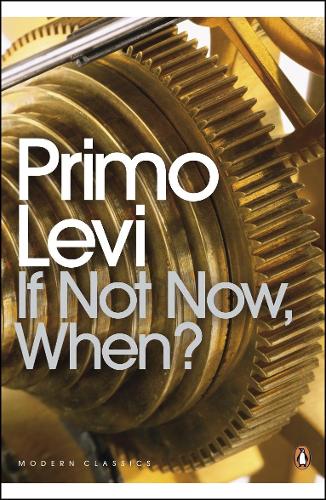
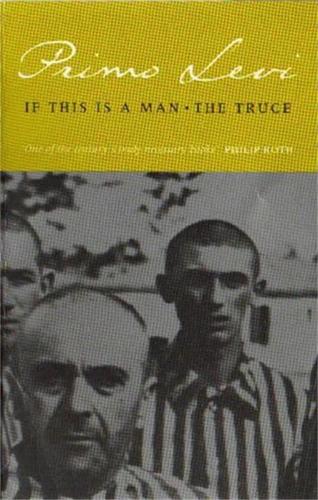
I have just finished reading this book. I found it poorly written, badly translated with storylines shoehorned in, just to try to give a potted history of Auschwitz. It skips in its timelines (8 months in one case), so flows badly & personally, I think it does a disservice to those that suffered at the hands of the Nazis. The lack of detailed descriptions that build a sense of the place really irritated - it isn't enough to say it was muddy, with ash in the sky. Likewise, the characters - her mother passing away should have been moving, but it left me cold (perhaps it was mean to) - telling the narrative from so many perspectives makes it feel like fiction (which clearly is, I don't believe for a minute that Dita met the Franks in Belsen-Bergen). The description of Belsen is the most engaging section (although it relys too heavily on describing it as chaos/anarchy without further expansion). This is a very poor take on the Tattoist of Auschwitz theme - there are other, better books that actually educate and leave a mark with their depth of description. Bypass this and buy a Primo Levi book.
Paperback edition
6th October 2020
Helpful? Upvote 11

An important must-read

A must-read fictional account very much based on the true story of Dita Krauss and her remarkable life and survival in the death camp of Auschwitz-Birkenau and later Bergen-Belsen. As a teenager she became the covert librarian of the banned literature that was hidden and used to teach the children of Theresienstadt Family Camp in Block 31.
It is an incredible book with vast amounts of historical information that needs to be publicly shared. Other reviewers have commented that it isn’t an emotional enough book or that something was lost in translation, however I disagree. The very subject is so grim and so utterly appalling already that to add in gratuitous emotion would be disrespectful and disingenuous and would turn something intense and moving into sensationalised disposable misery lit.
Having visited Auschwitz-Birkenau last year and seen and heard about the conditions within the camp and the vast scale of the genocide, this book has had a powerful effect on me.
I received a free copy of this book from the publisher via NetGalley in exchange for an honest review.
Paperback edition
13th July 2020
Helpful? Upvote 5
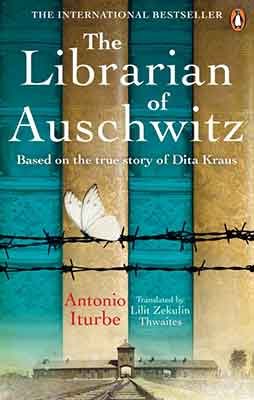
The Librarian of Auschwitz (Paperback)
The Librarian of Auschwitz (Paperback) Antonio Iturbe
Price: £10.99
9 Reviews Write your review
  • In stock

Usually dispatched within 1-2 days

  • This item has been added to your basket