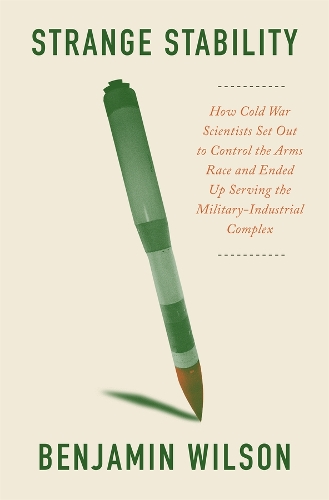
An eye-opening reconsideration of the Cold War arms control movement, showing how scientists who presented themselves as independent-minded opponents of the arms race in fact functioned as agents of the military-industrial complex that profited from it.
Do scientists speak truth to power? During the Cold War, a group of elite American strategists and science advisors claimed to do precisely that. Styling themselves as figures of rationality and restraint, they insisted that mutual assured destruction was the natural logic of the atomic age: as long as nuclear deterrence was credible, no one would ever shoot first. This doctrine, known as “strategic stability,” became the foundation of the arms control movement, earning its promoters widespread admiration as independent thinkers and steadfast peacemakers. But in this crucial counterhistory, Benjamin Wilson shows that we have misunderstood them and their efforts. Arms controllers, he reveals, worked not to restrain the nuclear arms race but to marginalize more radical approaches to disarmament.
As Wilson makes clear, strategic stability was never the objective condition the analysts presented it as. It was a flexible, contested metaphor based on ideas from physics, economics, and cybernetics, capable of justifying a wide range of policies. Yet the advisors insisted on one upshot above all: constant military research and development and the continuous upgrading of America’s strategic arsenal. That these policies benefited the military-industrial complex is no surprise, since many arms control thinkers were creatures of the Pentagon and corporate defense contractors. Some even spoke out against missile development in public while backing lavish funding behind closed doors.
Strange Stability powerfully corrects decades of mythmaking surrounding arms control. At the same time, Wilson offers a sobering reflection on the dream of technocratic restraint. The well-placed insider who resists powerful institutions is an enticing character, but more fictional than real.
Publisher: Harvard University Press
ISBN: 9780674976085
Number of pages: 488
Dimensions: 235 x 156 x 31 mm
Weight: 848 g
Language: English (Language of text), English (Original language of a translated text)
A thoroughly researched and informative account of how natural scientists and social scientists shaped debates over nuclear policy in the 1950s and 1960s…Wilson’s book is valuable as a guide for how individual thinkers turned their ideas into policy proposals. - Lawrence D. Freedman, Foreign Affairs
[Wilson] argues that Cold War-era debates over national security strategy and arms control were largely the product of elite scientists and engineers worried about the dangers of new military technologies, yet heavily dependent on ever-rising defense spending on scientific research and technological development for their careers and fortunes…To make his case, Wilson brings the receipts—literally…[while giving] scrupulous attention to the intellectual life of the individuals he studies. - Paul Erickson, Nature Physics
Wilson unearths a wealth of primary and secondary sources to challenge the image of sober and objective researchers with only national security and ‘strategic stability’ in mind. - Michael Axel, Proceedings
Eye-opening… a sharp puncturing of Cold War mythology. - Publishers Weekly (starred review)
Benjamin Wilson does something remarkable in Strange Stability. He shows how emerging mavens of nuclear strategy ported over concepts from unrelated fields, then wreathed them with mathematical formulas. Making a ‘science’ of nuclear deterrence, liberal experts managed to advocate for perpetual investment in research for bigger and better bombs while arguing that those same weapons should never be deployed. Even the peaceniks, Wilson shows, were heavily invested in the military industry. - Kate Brown, author of Plutopia
Strange Stability is an immensely important contribution to the history of Cold War science. Benjamin Wilson has written perhaps the first truly historical account of the role of liberal defense scientists in the arms race, arguing that they were effectively co-opted by the defense complex that they ostensibly set out to restrain. This is a solid, well-written, and provocative work of myth-busting scholarship, and a cautionary tale of collaboration and self-deception. - Alex Wellerstein, author of Restricted Data
The opaque world of nuclear strategy comes alive in Benjamin Wilson’s fascinating Strange Stability. By following the money as well as the science, and by making his case through careful research rather than sensational conspiracy theories, Wilson shows the military-industrial complex in a garish new light. In graceful prose and with a gift for storytelling, he dramatically pulls back the curtain of the national security state. - Andrew Preston, author of Total Defense
 Fermat’s Last Theorem
 Murderous Contagion
 The Tale of the Duelling Neurosurgeons
 Angel of Death
 The History of Medicine
 Voyages and Discoveries
 The Secrets of Alchemy
 Isaac Newton
 Science: A History
 What is Life?
 The Lunar Men
 The Information
 The Ascent Of Man
 Euclid's Window
Please sign in to write a review
Would you like to proceed to the App store to download the Waterstones App?